by Mike KasselPiano players have it easy. The piano keyboard clearly presents a pattern that makes it simple to learn the locations of its twelve tones (seven natural white-key notes and five sharp/flat black-key notes). Because the pattern repeats, piano players know the name of every note they play up and down the board.
It’s not as easy with fretted instruments. See?

While fretted instruments like ukulele lend themselves to persistent chord and scale patterns up and down the fingerboard, the individual notes, with their seemingly nonsensical repeating patterns at various places across the four strings, make it difficult to master the location of these notes. Thus, many of us learn to play ukulele by patterns or TABs and never get to know the notes and their locations. If you really want to progress in music, however, it is helpful to know the names of the notes you play.
I have struggled with this problem on bass and guitar for years and have finally come up with a way, at least on ukulele, to master where all the natural notes on the fingerboard lay (by natural notes, I mean the notes that are called
A, B, C, D, E, F and G as opposed to those called sharps and flats, such as A-sharp or G-flat—if you don’t know that this means, I will explain it below). While some note locations are more challenging to learn than others, I can show you a method that will, within a few minutes, help you master the location of one-third of the 48 notes as they exist on the first twelve frets of the ukulele fingerboard (the notes repeat at the twelfth fret, and ukulele players rarely play above that, so knowing these 48 will suffice).
First of all, you should know the names of your open strings (the notes that your strings sound when you are not putting your fingers on any of the frets). On ukulele, they are, looking down from the side of the ukulele that is closest to your face when you hold it in playing position,
G, C, E, and A. There are alternate tunings, but this is the standard way in which soprano, concert and tenor ukuleles are tuned:
G, C, E, and A. You need to know those. Because there are only 12 tones in music, the notes at the twelfth fret repeat those of the open strings, so if you know the names of the open strings, you know the names of the notes at the
twelfth fret—thus, you know one-twelfth of the 48 notes.
Now, get ready to learn, very quickly, another 8 notes.
First, you need to realize that except for the open strings and the notes at the twelfth fret,
there are only two other frets on which natural notes—notes that are not sharps or flats—appear across all four strings along a single fret; those frets are the
fifth fret and the
seventh fret (there are other all-natural frets above the
twelfth fret, but we are not dealing with those).
If you can remember that the notes at the
fifth fret spell the nonsensical word
C-FAD (I inserted the hyphen for clarity), and that the notes at the
seventh fret spell out the word
Do
GBon
E (the notes
D, G, B and E are the only ones that matter, as there are no Os or Ns in the musical alphabet), then you will know all the notes on the
fifth and
seventh frets in addition to the ones you know at the
twelfth. This may take a little time to master, but not too much.
Five is C-FAD and Seven is Do
GBon
E. That’s not so hard.
5 = C-FAD; 7 = Do
GBon
E.
Say it. Play it. You’ll get it. And, you’ll know twelve of the 48 notes, which is
one-quarter of the notes! Yeah!OK, let’s add another four notes, which will give us
our promised mastery of one-third of the first twelve frets of the ukulele fingerboard. The next four are actually quite easy to learn as they build off of the fifth and seventh fret knowledge you already have. If you already know about the musical alphabet and that sharps and flats exist between all natural notes except for those between the notes
B and
C and between the notes
E and
F, then you can skip the
section in green. If not, you need to read it before proceeding.
A Note on Sharps and Flats: In the musical alphabet, we have seven notes, or tones, comprised of the letters A, B, C, D, E, F, and G. For reasons not important to us now, there are 5 other notes, called sharps and/or flats, that exist on the very next fret above or below some of the letters. For example, the note at the fret following A is not B, but it is A-sharp, written as A#. After C, the note one fret up is a C#. After D, the note one fret up is a D#. After F, the note one fret up is an F#. And, finally, after G, the note one fret up is a G#. Flats work the same way, except backwards. One fret back from the A, for example, is the A-flat, written as Ab, which can also be referred to as a G-sharp, as it is also the note that is one fret up from the G. Look at the table to the left and see how this works.
Generally, if we are reading up the neck (towards the bridge of the ukulele), we call it a sharp, and if we read down the neck (towards the tuning pegs) we call it a flat. These, by the way, are the additional 5 of the 12 tones; why they exist as sharps or flats is not as important as just knowing that they do.Now, here is what is important about all of this: Between notes B and C and notes E and F there are no sharps or flats. Why? Who cares. That is just the way it is and you need to accept that. Thus, the note laying one fret up from B is not a B# (although you could call it that), it is a C. The note one fret down from a C, likewise, is not a Cb, but a B. Likewise with the E and the F; the note one fret up from the E is not an E#, but an F and the note below the F is not an Fb, but an E. The natural notes B and C and the natural notes E and F are always one fret away from each other while the natural notes A and B, C and D, D and E, F and G, and G and A are always two frets away from each other. Okay – back to mastering the ukulele fingerboard. Since we have a
C and an
F in
C-FAD at the
fifth fret, the notes going back down the neck, towards the tuning pegs on the fourth fret, are a
B and an
E. The
B, of course, is down one fret on the same string as the
C and the
E is down one fret on the same string as the
F. Since this happens on the
fourth fret on the first two strings closest to your face while holding the ukulele in playing position, I recall these two notes with the phrase
BE-4. In other words, the
B and the
E exist on the
fourth fret, one fret down from the
C and one fret down from the
F on the fifth fret.
Likewise, one fret above the
B and the
E on the
seventh fret’s DoGBonE that you have already learned are the notes
C and
F, with the C one fret above (towards the bridge) the
B, and the
F one fret above the
E. Thus, the
C and the
F lay on the
eighth fret on the two strings furthest from your face while holding the ukulele in playing position (see below).
Now, putting this all together, you can now locate the
B and
E on the
fourth fret and the
C and
F on the
eighth fret quite easily. Taken together with the notes we learned on the fifth and seventh frets, these represent what I call the
mega-cluster of notes on
frets four, five, seven and eight. Knowing this
mega-cluster gives you twelve notes, for a total mastery of 16 out of the 48. Thus, you know four frets worth of notes out of a total of twelve;
you can now locate one-third of the notes on the ukulele fingerboard! You now know where one-third of the notes are, and, as you can easily see, you can use these known notes to point to other notes. For example, since there is a
C on the
twelfth fret, there is a
B one fret down from it on the
eleventh fret. Two frets down from the
D on the
fifth fret must be a
C (on the
third fret). One fret up from the
C on the
fifth fret must be one of those sharps, in this case a
C#. The notes you now know can help you find the ones you have not yet memorized. Let’s learn more note locations.
Learning the rest of the natural notes

One note location you should know is the
C that lies on the
third fret on the string furthest from you face when holding the ukulele in playing position. Call this the
C-3. This note is related to the easiest ukulele chord, which is the
C chord. That
third fret is where you put your finger to sound the
C chord (which is, by the way, made up of the notes
C,
E and
G). So now you know
17 notes.

Another easy one is the one I call the
“Lonely F” as it is the
F that lays on that
first fret, right after that
open E. It is lonely because there are no other natural notes on that first fret. Remember,
E is one of the notes that is not followed by a sharp, so the note on the fret after
E must be
F. It is also a note used in one of the other easy ukulele chords you most likely know—the
F chord. You now know
18 note locations.
Since you know that
C-3 is on the
third fret, you know that the note down (back towards the tuning pegs) from it at the
second fret has to be a
B, as there is no
C-flat (remember, down means back towards the tuning pegs whereas up means towards the bridge). If you look closely, you can also surmise that the
G note on the
third fret is two frets higher above the
Lonely F on the first fret. Interestingly, this set of notes,
B,
G and
C, form a little triangle of natural notes on the
second and
third frets. So add another two notes for a total of
20 that you can locate.
There is one more triangle, the
EAF triangle, which exists at
frets nine and ten; notes
E and
A are on the
ninth and
F is on the
tenth, one up, of course, from the
E. Once you learn it, you have three more notes you can locate for a total of
23.
By the way, another location device you can use for finding the notes on that part of the fingerboard is the
diagonal spelling of the word FACE that exists among the notes
F on the
tenth fret,
A on the
ninth,
C on the
eighth, and
E on the
seventh. These are notes we already found using other strategies, but it is another helper we can use to reinforce note location.
Let’s ad another two notes. Look at the first two strings closest to your face when you are holding the ukulele in playing position and you find an
A two frets up from the
open G and a
D two frets up from the
open C, spelling out the word
AD. I recall this as the
AD-2 location (kind of like the
BE-4 that lays two frets up from the
AD-2 at the
fourth fret). Master these and you know
25.
Believe it or not, there are only three more natural notes to locate, and those are pretty easy to find. The easiest of the three is the
B which exists in the
eleventh fret down from the
C in the
twelfth fret. It is a
Lonely B, as there are no other natural notes on the fret.
 The remaining two natural notes
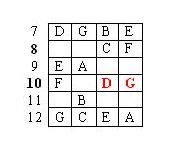
 have two known markers that you have already learned. Two frets above the
C and the
F on the
eighth fret part of the
mega-cluster are the
D and the
G on the
tenth fret. Those, by the way, are also two frets down (towards the tuning pegs) from the
E and the
A on the
twelfth fret, part of the first full fret location you learned.
So we now know the location of all 28 of the natural notes (not counting, of course, the other four open natural notes
G, C, E, and
A). If this seems a little overwhelming, just master the first one-third up through the mega-cluster described in the first section and work with the other ones later. Soon, that jumble of notes will begin to make sense. Then you can start learning the location of the sharp/flat notes.
Locating Ukulele sharps and flats
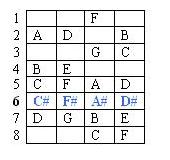
There are 20 sharp/flat notes on the first twelve frets of the ukulele fingerboard. Note that the only fret that has all sharp/flat notes across it is the
sixth; all the rest of the frets, except for
five,
seven and
twelve, have at least one sharp/flat note across it. Here is the line of sharps on the
sixth fret, which we can think of as the
C# line:
Those could also be read as the Db line as well:
As you can see by the table above, each fret has the following number of sharp/flat notes:
1st fret = 3 sharp/flat notes
2nd fret = 1 sharp/flat notes (call it the
Lonely F#/Gb)
3rd fret = 2 sharp/flat notes
4th fret = 2 sharp/flat notes
5th fret = 0 sharp/flat notes
6th fret = 4 sharp/flat notes
7th fret = 0 sharp/flat notes
8th fret = 2 sharp/flat notes
9th fret = 2 sharp/flat notes
10th fret = 1 sharp/flat notes (call it the
Lonely A#/Bb)
11th feet = 3 sharp/flat notes
12th fret = 0 sharp/flat notes
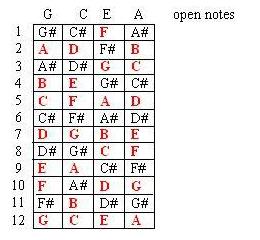
Once again, to the right are all of the notes on the first twelve frets (I am using sharps for the non-natural notes, but they could also be referred to by their flat name as well). The natural notes are highlighted in red to show the shapes of the location structures we have identified. Note again the
mega-cluster of natural notes on frets
four, five, seven and
eight, as these are your most helpful guides. Also note the
BE-4,
C-FAD, Do
GBon
E, and
CF structures within the
mega-cluster, along with the
Lonely F, the
BGC (which includes the C-3) and
EAF triangles (which comprises part of the
diagonal spelling of FACE), the
AD-2 on the
second fret, the
DG on the
tenth fret, the
Lonely B on the
eleventh fret, and, of course, the
GCEA across the
twelfth fret, which is where it all started. This should all look a little less confusing than when you first saw it, and not just because the natural notes are highlighted in red. You may not know all of them yet by heart right now, but using the
twelfth fret knowledge coupled with the
mega-cluster at
frets four, five, seven and
eight, will give you easy mastery of at least one-third of the natural notes. When you know the notes you are playing, you can then move into more advanced topics like how to build chords and other music theory questions. Then you'll really be cookin'.
By the way, a great place to put this note-location into action is at
liveukulele, which has tons of lessons and information on chords and theory -- it's great (and, no, I am not affiliated with the site nor am I being paid to suggest it).
- Lamb Chop
copyright 2010, Mike Kassel